Animation has always been where art meets innovation, but now, AI in animation is rewriting the script. Today, animation technology is fueling a creative revolution, making animation technology faster, more flexible, and more accessible. From indie creators to 3D animation studios, the playing field is leveling. The global animation industry, valued at $436.24 billion in 2024, is projected to reach $428.084 billion in 2025 and grow to $574.702 billion by 2030 at a 6.07% CAGR. With streaming platforms driving demand, motion graphics and immersive stories are reaching massive global audiences. In this explosive growth, the blend of AI and machine learning with storytelling marks a defining shift in how we create, animate, and captivate.
Need stunning explainer video animation or game art? ICE Animations offers full-spectrum professional animation services, from concept to post-production. If you want animated cartoons for your brand, contact us today at ICE Animations.
What Is Animations Technology?
Put simply, animation technology is everything that helps breathe life into drawings, models, or characters. It includes classic 2D animation and modern 3D animation tools like Blender, Autodesk Maya, and Adobe Animate, as well as powerful game engines like Unreal Engine and Unity.
Once rooted in hand-drawn cels and stop motion animation, animation now spans complex digital workflows, complete with motion capture, real-time 3D animation pipeline, and virtual production stages. Whether it’s for film, games, or marketing, animation technology is the foundation of every visual storytelling experience.
From stylized 2D to hyper-realistic 3D, ICE Animation’s 3D animation studios use top-tier cloud-based animation tools to bring your creative visions to life. Visit the ICE Animations website for custom animation services tailored to your needs.
Animation Technology and Innovation
The animation industry’s rapid growth is fueled by continual technological innovation. Key trends include:
- AI and Machine Learning: Artists use AI animation tools for concept art, automatic in-betweening, and even scripting ideas. Studies show nearly all entertainment companies (99%) plan to integrate AI and ML into their pipelines. Startup tools and big names alike (Adobe, Autodesk, NVIDIA) are racing to apply generative AI animation, which streamlines routine tasks and unlocks creative processes.
- Real-Time Rendering: Game engines like Unreal and Unity now render film-quality animation instantly, dramatically cutting production time. Directors can preview scenes on the fly (as seen in virtual production stages) and iterate faster than ever.
- Immersive Tech (AR/VR): Augmented and virtual reality are creating new ways to experience animation. By 2025, AI-powered hyper-realistic animations and immersive AR/VR experiences are expected to become mainstream. Audiences may soon step inside animated worlds for interactive storytelling.
- Accessible tools and cloud pipelines: Open-source software (e.g., Blender) and cloud-based animation tools are lowering barriers. Small studios and indie creators can leverage the same animation technology once reserved for big studios.
The AI animation tools market itself is exploding. It’s projected to grow from $2.99 billion in 2024 to $37.8 billion by 2035, driven by demand for automated rigging AI tools, 3D asset creation, and other AI-driven features.
Did you know? The AI animation tools market is set to hit $37.8 billion by 2035, with tools like Cascadeur handling up to 50% of routine character animation tasks by 2025.
Looking for advanced animation studio? ICE Animations helps businesses bring their stories to life with world-class visuals.
What Is Technical Animation?
While animators breathe personality into characters, technical animation ensures those characters move realistically and efficiently. They handle everything from rigging (building the digital skeletons) to simulations (like how hair flows or clothes flutter).
At ICE Animations, our technical animators bridge code and creativity. Using tools like physics engines and AI-assisted simulations, they make animations not just beautiful, but believable via technical animation workflow.
Want your character to move like magic? Let our technical animators do the heavy lifting with expert rigging and AI-assisted character animation. Ready for AI-powered motion capture in your project? Contact ICE Animations today!
How Animation Techniques Evolved
Animation techniques have multiplied in variety with new technology. What are animation techniques? They range from the traditional to the cutting-edge:
- 2D Hand-Drawn/Digital: The classic style, where each frame is drawn by hand or with a graphics tablet. Digital tools have modernized this (e.g., vector animations or digital “cel” shading), but the principle is the same as old Disney or anime.
- 3D Computer Animation: Characters and sets are built as 3D models, rigged with virtual skeletons, and animated in 3D space. This is used by Pixar, DreamWorks, and most modern animated films and games. Techniques include keyframe animation, AI-powered motion capture, and procedural animation. Studios often rely on 3D animation companies or 3D animation agencies for specialized 3D character animation and 3D product animation.
- Stop-Motion and Practical: Real objects (clay figures, puppets, LEGO) are physically moved and photographed frame-by-frame. Studios like Laika combine stop motion with digital effects.
- Motion Capture: Specialized cameras and markers capture an actor’s movements and apply them to digital characters. AI is making it cheaper with phone apps and AI mocap services like DeepMotion Animate 3D.
- Hybrid/Experimental: Mixing styles such as 2D/3D hybrid (like Spider-Man: Into the Spider-Verse), or real-time animations inside games and VR. Developers also experiment with deep learning AI for neural style transfer animation.
Did you know? By 2025, AI could automate 50% of standard character animation tasks like in-between.
AI in Animation: A Creative Revolution
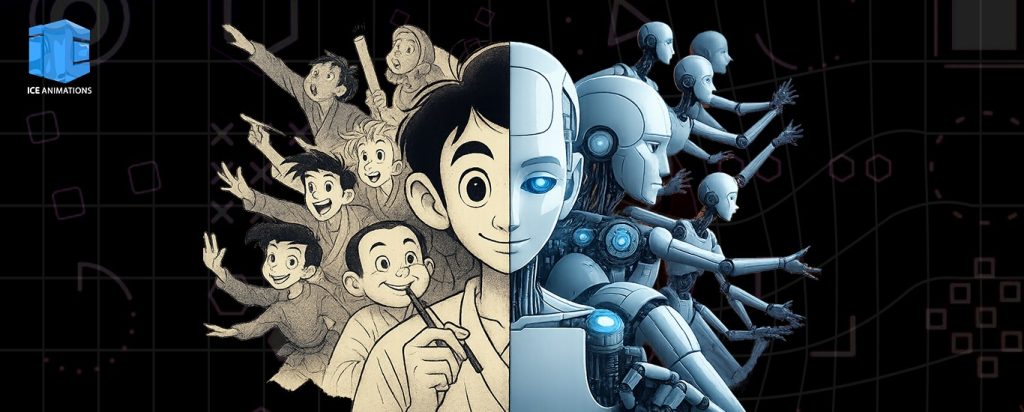
AI in animation isn’t just a buzzword. Here’s how animation AI is transforming workflows:
- Concept Art & Storyboarding: Generative AI like DALL·E 3, Stable Diffusion.
- Character and 3D Asset Creation: AI-powered model generators and auto-riggers.
- Motion and Effects: Tools like Cascadeur and DeepMotion use physics and AI to produce lifelike motion.
- Voice and Dialogue: AI voice tools like ElevenLabs or Replica Studios.
One of the best examples? Frozen II used AI tools to generate realistic snow and lighting.
You don’t need a Disney-sized team to get incredible visuals. ICE Animations helps animation projects of all sizes tap into AI-powered animation.
Did you know? North America holds the largest share of the global animation market in 2025, driven by demand for AI-enhanced content.
The Future of Animation
Sustainable animation with AI promises even more change ahead. Experts predict AI-powered hyper-realistic animation will become mainstream by 2025, with immersive experiences.
Interactive motion design will grow: branching narratives, animated VR worlds.
Story First, Tech Second. Always!
ICE Animations is a leading animation studio and creative animation agency blending traditional creativity with AI.
FAQs
How can AI be used in animation?
AI is transforming animation workflows by automating repetitive tasks and enhancing creativity. It can generate concept art, auto-rig 3D models with generative AI animation software, fill in-between frames, colorize sketches, simulate realistic motion (like cloth or hair), and even clone voices from scripts. AI tools like Cascadeur, NVIDIA GauGAN, Runway ML, and ElevenLabs are helping artists focus more on storytelling while reducing production time.
Is AI replacing animators?
No, AI isn’t replacing animation; it’s empowering it. While AI handles some technical or time-consuming steps like automated rigging, human creativity, direction, and storytelling remain central. AI is more like a smart assistant than a replacement, helping artists explore ideas faster and work more efficiently.
Will AI make animation easier?
Absolutely. AI simplifies many labor-intensive parts of animation, like background creation, lip-syncing, or frame interpolation with AI animation software. This means animators can spend less time on routine tasks and more on designing engaging characters, refining motion, and perfecting the visual narrative.
Will animators get replaced by AI?
No, AI won’t replace animators. While AI automates repetitive tasks like rigging and motion simulation, human creativity, storytelling, and direction remain essential. AI is a tool that enhances an animator’s workflow, not a replacement for their role.
How does artificial intelligence technology influence animation creation?
AI speeds up tasks like rigging, motion simulation, and rendering with AI-powered motion capture, allowing animators to focus on creativity. It also opens up new possibilities for 3D animation and lifelike effects.
Is there an AI animation software?
Yes, several AI-powered tools are changing how animations are made. Examples include:
- Cascadeur (for physics-based animation)
- Runway ML (for generative video)
- NVIDIA GauGAN (for environment design)
- Adobe Sensei (built into Adobe’s creative suite)
- Kling AI (for realistic video generation)
- ElevenLabs and Replica Studios (for AI voiceovers)